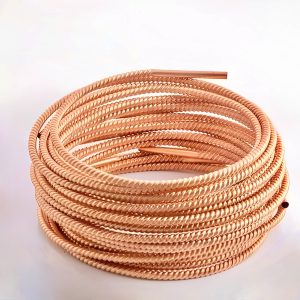
Tubos de cobre y níquel C71500

Copper-nickel (also known as cupronickel) alloys offer excellent corrosion resistance to seawater and good fabricability. The addition of nickel to copper improves strength and corrosion resistance while allowing the alloy to remain ductile, other elements can be added to copper-nickel to increase strength, Resistencia a la corrosión, hardening, weldability and castability. The nickel-copper alloy has been widely used for r marine applications. C71500 copper alloy, often known as 70/30 copper-nickel, is the alloy with 70% copper and 30% nickel content(as well as C71640), it has higher nickel content than that of C70600 which are more highly alloyed with aluminum, chromium, or tin are used where greater resistance to seawater environments, sand abrasion, wear and galling, as well as higher mechanical properties, are required.
The copper alloy products provide by Tubesolutions shall be fabricated from prime quality raw materials and is fully certifiable to industrial specifications like ASTM and ASME or other relevant standards. Wiho metals mainly supply and stock a large inventory of alloy Copper C71500 (C7150T/CW354H) seamless tubing in accordance with ASTM B466 used for condensers, Intercambiadores de calor, Power Steering Tube, Brake Lines applications.
- Descripción
- Indagación
Descripción
Copper Nickel tubes, 30% – C71500 – has, in general, the best resistance of any of the copper alloys to impingement attack and to corrosion from most acids and waters. It is being used in severe corrosive conditions in which service lives longer than those of other copper alloys are desired.
C71,500 is a corrosion-resistant alloy suitable for use in marine climate conditions. It is often made into pipes for use. Sin embargo, because the nickel content is up to 30%, the solidification temperature range is as wide as 66 ℃, and the thermal conductivity at room temperature is only 1/13 of that of pure copper, the casting defects such as shrinkage cavity, porosity, dendrite segregation, and hot cracking are greatly increased.
C71500 white copper tube heat exchanger tube
C71500 white copper has the same properties and uses as C70600, with good cold and hot workability. Scope of application: copper nickel alloy tubes for condensers and heat exchangers, water evaporators, boiler blowdown heat exchangers, air coolers, gland steam condensers, steam ejectors, turbine oil coolers, fuel heaters, compressed air intercoolers and aftercoolers, ferrules, oil well pump liners, distillers, etc..
● Chemical composition: copper+alloy element Cu: ≥ 99.5, copper+silver Cu+Ag: ≤ 65.5, lead Pb: ≤ 0.05 ①, iron Fe: 0.40~1.0, zinc Zn: ≤ 1.0 ①, nickel Ni: 29.0~33.0, manganese Mn: ≤ 1.0

C71500 white copper tube
In the current pipe making process, alloy billets are cast semi continuously. This preparation method has a large pouring drop, and the molten metal is prone to entrapment of gas and inclusions, leading to a low qualification rate of ingots;
The ingot is also subjected to 25 complex pipe making processes such as hot extrusion, cortante, wound skin, repeated drawing, pickling, etc., resulting in great metal loss; These factors make the overall yield of pipe manufacturing only 25%~33% (about 50%~53% abroad), which greatly wastes materials and energy. Por lo tanto, how to improve the yield and process structure,
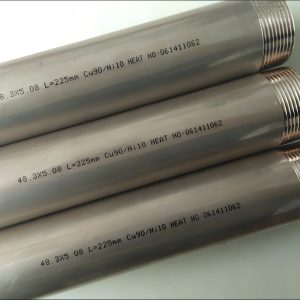
C71500 copper nickel, also known as 70/30 copper nickel alloy, BFe30-1-1, CuNi30Mn1Fe, has excellent corrosion resistance, especially in marine salt water environment. The main wrought copper nickel alloys used in seawater service contain 30% níquel.
Aplicaciones
The 70-30 copper-nickel alloys have used saltwater and cover thermal desalination, offshore oil and gas, marine shipping, power generation and commercial. Copper-nickel alloys are also used for seawater cooling and firewater systems, hydraulic tubing, Intercambiadores de calor, evaporator Tubes and condensers, including brake tubing, platform riser and antimicrobial touch surfaces.
| UNS No. | C71500 – BSI No. CN107 – ISO Name CuNi30Mn1Fe |
| Comp Químico. (%) | Cu rem / Ni 29 ~ 33 / Pb 0.05 / fe 0.40 ~ 1 / zinc 1 máximo |
| Especificaciones ASTM. | B 111, B 359, B395, B 466, B 467, B 543, B 552 |
| Especificaciones ASME. | SB 111, SB 395, SB 466 |
| Aplicaciones | Condensador, Evaporator and Heat Exchanger tubes; Distiller tubing; Salt Water piping. |
| Atemperar | O61 Recocido / HR50 Drawn & Stress Relieved |
| Propiedades * | Métrico | Inglés |
| Densidad | 8.94 g/cc | 0.323 libras/pulg.³ |
| Tensile Strength min.- O61 -/- HR50 | 360 MPa -/- 495 MPa | 52 Ksi -/- 72 Ksi |
| Yield Strength min.- O61 -/- HR50 | 125 MPa -/- 345 MPa | 18 Ksi -/- 50 Ksi |
| CTE, lineal | 16.2 10-6/°C @ 20.0 – 300 °C | 9.0 10-6/°F @ 70.0 – 570 °F |
| Capacidad calorífica específica | 0.09 cal/g-°C @ 20ºC | 0.09 BTU/lb-°F @ 70ºF |
| Conductividad térmica | 29 W/m-K @ 20.0 °C | 17 BTU/ft2/ft/h/°F @ 70.0 °F |
| Punto de fusión | 1171 – 1238 °C | 2140 – 2260 °F |
Si tiene alguna pregunta,Le invitamos a ponerse en contacto con usted sales@tubesolutions.com.cn
Material | ASTM :Cobre (C10200,C11000,C10100,C10200,C12000,) Latón(C21000,C22000,C23000,C24000,C26000,C27000,C27200,C27400,C2800,C31400, C33000,C35600,C37100,C36000, C35300,C37100,C37700,C37710,C37000,C68700,C41100, C44300,C46200.C46400,C26130,C65600,) Bronce(C50500,C51100,C52100,C60800,C61000,C61900,C63010, C62300,C63000,C63280, C63020,C17200,C17000,C17500,C17510,C18200,C18100,C18200,C16200,C19400,C14500) Cupronickel(C70400,C71000,C71300,C71500,C70400,C70600,C75200,C77000,C75400,) | |||
Pipe shape | Redondo, square, rectangular | |||
Pipe specification | Redondo | Espesor de pared:0.20mm-20mm | ||
OD:2.00mm-400mm | ||||
Cuadrado | Espesor de pared:0.2mm-20mm | |||
OD:5mmX5mm-400mmX400mm | ||||
Rectangular | Espesor de pared:0.2mm-20mm | |||
OD:5mmX6mm-380mmX400mm | ||||
Pipe length | 1/16 hard,1/8 hard,3/8 hard,1/4 hard,1/2hard,full hard,suave,etc. | |||
Surface treatment | mill,pulido,brillante,oiled,hair line,brush,mirror,sand blast,or as required. | |||
Aplicación | The copper tubes are made of pure electrolysis copper. They are precise in size and smooth on surface. Besides,they are of good heat conductibility. Thus, they are widely used for heat exchangers, radiators, coolers, electro-heat-up pipe, Air conditioner and refrigerators. The straight pipes can be used for oil transportation, brake pipes, water pipes and gas pipes for construction. | |||
Paquete | Paquete estándar de exportación: bundled wooden box or be required; The packing will reach the standard of export. Or as the customers’ request. Además, We will make the products with good surface protection. | |||

White copper tube is a metal pipe made of copper nickel alloy as the substrate, named after its silver white metallic luster on the surface. This type of pipe perfectly combines the excellent processing performance of copper with the corrosion resistance of nickel, playing an irreplaceable role in fields such as marine engineering, chemical engineering, and energy, and can be regarded as the “pioneer of corrosion resistance” in industrial materials.
1、 Material composition and classification
(1) Core alloy composition
The basic components of white copper tube are copper (Cu) and nickel (Ni), which can be divided into various types according to the different nickel contents:
B10 white copper tube: containing about 10% nickel and about 90% cobre, it is one of the most common white copper tubes with balanced comprehensive performance.
B30 white copper tube: containing about 30% nickel and about 70% cobre, with stronger corrosion resistance, especially suitable for extreme corrosive environments.
Other models, such as B20 and BFe10-1-1 (with a small amount of iron), optimize their performance by adding elements such as iron, manganeso, and zinc.
(2) Classification method
Classified by purpose:
White copper tube for condensation: used in equipment such as heat exchangers and condensers, utilizing its good thermal conductivity and corrosion resistance.
Structural white copper tube: used for mechanical structures and piping systems, emphasizing strength and fatigue resistance.
Classified by production process:
Squeezed white copper tube: suitable for large-diameter, thick walled pipes with high strength.
Drawn white copper tube: high precision, smooth surface, mostly used for precision instruments or small-diameter pipelines.
2、 Core performance advantages
(1) Excellent corrosion resistance
Corrosion resistance of seawater: The corrosion rate in seawater is only 1/20 of ordinary carbon steel, even lower than stainless steel, making it a “estándar” material for marine engineering. Por ejemplo, B10 white copper pipes are commonly used in ship seawater cooling pipelines and offshore platform water delivery systems to avoid the risk of leakage caused by seawater corrosion.
Chemical medium resistance: It has good resistance to chemical solutions such as sulfuric acid, hydrochloric acid, and caustic soda. When used in the chemical industry to transport corrosive media (such as acidic solutions in fertilizer production), its service life far exceeds that of ordinary metal pipes.
Stress corrosion cracking resistance: In environments containing chloride ions (such as coastal industrial areas), stress corrosion cracking is less likely to occur, while stainless steel is prone to intergranular corrosion in such environments.
(2) Excellent physical and mechanical properties
Thermal conductivity: The thermal conductivity coefficient is about 1/3 of copper, which is lower than pure copper but better than most stainless steels. It is suitable as a heat exchanger tube (such as power plant condensers and air conditioning condensers).
Strength and toughness: The tensile strength can reach 300-500MPa, with an elongation of over 20%. It can withstand high pressure (such as high-pressure steam pipelines) and adapt to vibration or bending conditions (such as ship shaking environments).
Temperature resistance: The performance is stable within the temperature range of -200 ℃ to 300 ℃, without embrittlement at low temperatures, and has strong oxidation resistance at high temperatures (nickel element forms a dense oxide film NiO).
(3) Processing and welding performance
It can be processed into various specifications of pipes through processes such as cold drawing and hot rolling, and can also undergo forming operations such as bending and expanding.
Good welding performance, when using argon arc welding, electric arc welding and other processes, no special flux is required, and the weld strength is close to the base metal.
3、 Typical application scenarios
(1) Marine engineering field
Construcción naval: As a seawater cooling system pipeline (such as diesel engine cooling water pipeline), acerca de 60% of B10 white copper pipes are used in the shipbuilding industry worldwide every year; In the seawater desalination system of luxury cruise ships, B30 white copper pipes can resist corrosion from high concentration saltwater.
Marine platforms: The seawater injection system of offshore oil drilling platforms and the water transmission pipelines of tidal power plants rely on the corrosion resistance of white copper pipes to achieve long-term stable operation.
(2) Chemical and Energy Industry
Chemical equipment: Transporting caustic soda solution in chlor alkali industry, ammonia containing medium in fertilizer plant, corrosive chemical solution in pharmaceutical plant. White copper tube can reduce the risk of medium pollution (copper nickel alloy itself is non-toxic).
Power industry: B10 white copper pipes are used in thermal power plant condensers to condense steam into water, and B30 white copper pipes are used in nuclear power plant seawater circulation systems to transport cooling water sources, ensuring safe operation of equipment.
(3) Other special fields
Salt production and food industry: brine conveying pipelines in salt production equipment and acidic beverage conveying pipelines in food processing plants, utilizing their corrosion resistance and hygiene properties (copper ions have a certain antibacterial effect).
Instruments and precision instruments: used for manufacturing pressure sensors, thermometer sleeves, or corrosion-resistant pipelines in medical devices due to their high material stability.
5、 Key points for selection and maintenance
(1) Selection suggestions
Select nickel content based on the corrosiveness of the medium: B10/B30 is preferred for seawater environments, and B30 or models with added alloy elements (such as BFe30-1-1) can be selected for strong acid-base environments.
Choose wall thickness based on pressure and temperature: for high-pressure conditions (>10MPa), thicker pipe walls are required, and for high temperatures (>300 ℃), B30 material should be considered.
(2) Maintenance precautions
Avoid contact with dissimilar metals (such as direct connection between copper and steel) to prevent electrochemical corrosion.
Rinse the medium inside the pipe with clean water before long-term shutdown, especially after transporting seawater or chemical solutions, to reduce residual corrosion of the medium.
If there is a slight oxide layer on the surface, it can be wiped with a soft cloth dipped in a special copper alloy cleaner, and cannot be scraped with hard objects such as steel wire balls.
From the era of steamships a hundred years ago to today’s deep-sea exploration projects, white copper pipes have always guarded industrial pipeline systems with the attitude of being “resistente a la corrosión”. With the development of new energy, ocean development and other fields, this copper nickel alloy pipe will demonstrate its value in more extreme working conditions and become an important bridge connecting material science and engineering applications.