CRA Tubes & Pipes

Stainless steel lining technology involves using thin-walled stainless steel pipes as carriers. After welding and forming, a traction winch is used to pull the stainless steel lining pipe from one end of the pipeline to be repaired to the other end. After the stainless steel lining pipe is inserted, it is pressed, and under pressure maintenance, grouting and curing operations are carried out on the gap between the lining pipe and the original pipeline. This forms a composite pipe that is tightly bonded to the original pipeline and has a smooth surface. This achieves the repair goals of high pressure resistance, impact resistance, and overall corrosion resistance, extending the service life of the original pipeline by more than 50 years.
The inner wall of the lined pipe is smooth and resistant to scaling, reducing operational friction and saving energy costs in transportation. It can effectively prevent secondary pollution. Due to the presence of 18% chromium in steel, a very thin chromium oxide film forms on the inner wall of the pipeline during use. This film prevents further oxidation of the metal, giving stainless steel strong corrosion resistance. It can withstand corrosion not only from water and air but also from weak acids and alkalis. The thickness of the stainless steel lining ranges from 1 to 3 millimeters, while the thickness of the galvanized layer on galvanized steel pipes is only 0.07 millimeters, a difference of 14.2-42.9 times. Stainless steel also has stronger corrosion resistance and compactness than the galvanized layer of galvanized steel pipes. Therefore, there is no need to worry about scaling or nodule formation due to corrosion of the inner wall, which can narrow the inner hole, when using lined stainless steel composite steel pipes.
- Description
- Inquiry
Description
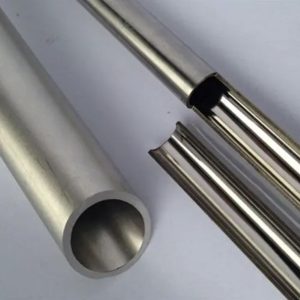
Lined stainless steel clad pipe (also known as bimetallic clad pipe) is a type of bimetallic pipeline that utilizes a carbon steel pipe as the base pipe and is clad with a stainless steel lining layer through processes such as reducing, cold expanding, deflagrating, or brazing. It adheres to the construction industry standard CJ/T192-2017. The outer base pipe can be made of galvanized steel, seamless steel, or spiral welded steel, and the lining material is food-grade stainless steel such as 304 and 316L. This pipe not only enhances the corrosion resistance of steel pipes but also retains the mechanical strength and good sealing properties of carbon steel pipes. The stainless steel layer is 0.4-1.2 millimeters thick, suitable for temperatures ranging from -40 to 350°C, and supports welding, flange, threaded, and grooved connections. It is used in water supply, gas, fire protection, petrochemical, and other industries. Typical cases include the Three Gorges Project and the G20 Hangzhou International Expo Center. The outer base pipe complies with GB/T3091 or GB/T8163 standards, and the inner stainless steel pipe follows GB12771 standards. The two are clad through a rolling process, with a bonding strength exceeding 0.2 MPa. The lined stainless steel layer achieves acid and alkali corrosion resistance through a chromium oxide film, effectively preventing scaling and secondary pollution, while the outer carbon steel ensures compressive and impact resistance. This pipe combines the corrosion resistance of stainless steel with the pressure-bearing capacity of carbon steel, saving 30%-50% in material costs compared to pure stainless steel pipes and having a service life of up to 50 years. In municipal water supply, chemical corrosion prevention, and other fields, duplex stainless steel lining can be used to enhance resistance to chloride ion corrosion, and the outer coating can be treated with hot dip galvanizing or polyethylene for corrosion protection
Technical characteristics of stainless steel-lined composite steel pipes.
The stainless steel-lined composite steel pipe is a composite pipe material made by combining a specially treated galvanized steel pipe with an argon arc welded thin-walled stainless steel pipe (304 or 316) through a special process. Due to its unique structure, it possesses the following technical characteristics:
1. High bonding strength. There are two different composite processes for existing stainless steel-lined composite steel pipes: one is to bond two layers of metal pipes with different materials, the inner and outer layers, using hot melt adhesive. This process is simple to process, and because hot melt adhesive is a polymer resin with very reliable insulating properties, it can insulate the outer galvanized steel pipe from the inner stainless steel pipe, preventing the tendency of galvanic corrosion between the two different metal materials. However, this process seriously affects the bonding strength of the composite pipe material, especially in applications with higher operating temperatures and as the usage time progresses. Hot melt adhesive will soften and age, making it difficult to avoid delamination and loosening between the inner and outer layers of materials. The other process does not use hot melt adhesive for bonding, but instead employs mechanical interference fit to combine the steel pipe and stainless steel. This process is more complex, but because there is no softening and aging issue with the bonding layer, the bonding strength between the inner and outer layers of materials is very high, and delamination and loosening of the materials does not occur. At the same time, because the inner weld ribs of the welded steel pipe are removed before composite, there is 100% effective contact between the carbon plastic steel pipe and the stainless steel pipe, and there is no electrolyte coverage in the contact area, so small anodes and large cathodes do not form, effectively solving the galvanic corrosion problem between the two different metal materials. Therefore, in applications with higher operating temperatures, the latter process for processing stainless steel-lined composite steel pipes should be adopted as much as possible.
2. Small coefficient of thermal expansion. Both the inner and outer layers of the stainless steel-lined composite steel pipe are made of metallic materials, with their coefficients of thermal expansion being essentially consistent and less than 1.6×10⁻⁵/℃. This is advantageous for use in situations where the operating temperature is high.
3. Strong corrosion resistance. The inner layer of the stainless steel-lined composite steel pipe is made of 304 stainless steel, which exhibits strong corrosion resistance to acids, alkalis, salts, etc. It can well meet the corrosion resistance requirements for water supply systems that comply with the national standard for chlorine ion content in tap water (if the water supply system exceeds the national standard for chlorine ion content in tap water, the inner layer should be made of 316 stainless steel). The outer layer of the stainless steel-lined plastic-coated steel pipe has undergone a dual anti-corrosion treatment of galvanizing and baking paint, which not only provides an extremely beautiful appearance but also helps extend the service life of the pipe material.
4. High heat resistance. The stainless steel lined composite steel pipe, processed using interference fit technology, exhibits high heat resistance due to the absence of any organic materials. If its fittings are made of high heat-resistant sealing and anti-corrosion materials, it can constitute an excellent pipeline for high-temperature fluid transportation.
5. The connection method is flexible and reliable, offering high cost-effectiveness. Currently, stainless steel pipelines and steel pipeline systems used in high-temperature fluid transportation have to adopt thin-walled pipes to reduce costs. However, due to their low strength and susceptibility to deformation, thin-walled stainless steel pipes and copper pipes can only be connected through direct welding or quick-fitting methods. In installation scenarios where open flames are not allowed, and considering the low support strength of thin-walled pipes for clamping rings during quick-fitting connections, the flexibility and reliability of the connection method are greatly impacted. Lined stainless steel composite steel pipes, on the other hand, not only enhance the overall strength of the composite pipe material due to the reinforcement of the outer steel pipe, but also increase the flexibility and reliability of the connection method. Depending on different usage scenarios, various types of pipe fittings such as welded, threaded, clamping ring quick-fitting, or flange connections can be selected for effective connection, thereby greatly expanding its effective application range and improving cost-effectiveness.