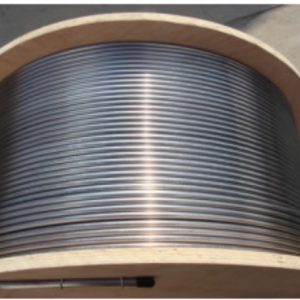
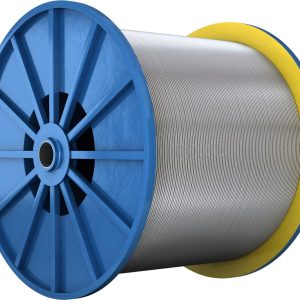
Medical Stainless Snake Bone Tube

Medical Stainless Snake Bone Tube

Medical stainless bone tubes are indispensable cornerstones of modern orthopedic and surgical care, integrating advanced materials science, precision engineering, and strict medical regulation. Their unique combination of biocompatibility, mechanical strength, corrosion resistance, and processability supports life‑changing treatments for fractures, deformities, and skeletal disorders worldwide. As technology advances, these tubes will continue to evolve with enhanced functionality, personalized design, and smarter performance, further improving surgical outcomes, reducing patient suffering, and promoting the development of minimally invasive and precision medicine. For manufacturers, surgeons, and healthcare providers, investing in high‑quality medical stainless bone tubes remains essential to delivering safe, effective, and affordable orthopedic care.

Description

Medical Stainless Bone Tube: A Comprehensive Overview

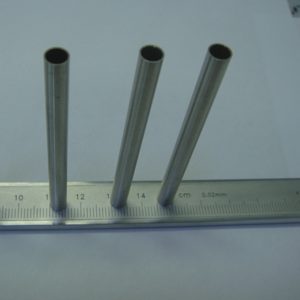
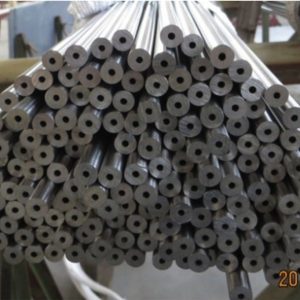
Medical stainless bone tubes represent a class of high‑precision, bio‑compatible hollow cylindrical components engineered specifically for orthopedic surgery, trauma fixation, minimally invasive procedures, and implantable medical devices. Manufactured from medical‑grade stainless steel alloys under strict ISO and FDA regulatory standards, these tubes combine exceptional mechanical strength, corrosion resistance, and tissue compatibility to support bone healing, structural stabilization, and surgical precision. Unlike general industrial tubing, medical stainless bone tubes undergo rigorous purification, precision machining, and surface finishing to eliminate contaminants, control dimensional tolerances at the micron level, and ensure long‑term safety within the human physiological environment. As a foundational material in modern orthopedics, they have revolutionized fracture treatment, limb reconstruction, spinal surgery, and minimally invasive surgical techniques, significantly improving patient recovery outcomes and reducing post‑operative complications.

Material Specifications and Core Properties

The dominant material for medical stainless bone tubes is 316L surgical stainless steel, a low‑carbon austenitic alloy containing chromium, nickel, and molybdenum. The low carbon content (≤0.03%) prevents carbide precipitation during welding and heat treatment, preserving corrosion resistance and minimizing the risk of ion leaching into bodily fluids. Molybdenum enhances resistance to pitting and crevice corrosion caused by chloride ions in blood, interstitial fluid, and saline environments, making it highly stable in long‑term implant applications. High‑purity variants such as 316LVM (vacuum‑melted) further reduce inclusions and impurities, meeting the strictest standards for implantable devices.
Key performance properties include:
  • Excellent biocompatibility: Non‑toxic, non‑allergenic, and non‑inflammatory, avoiding adverse tissue reactions or immune rejection.
  • High mechanical strength: Tensile strength exceeding 515 MPa, with good toughness to resist fracture under dynamic loading.
  • Superior corrosion resistance: Resistant to intergranular corrosion, stress corrosion cracking, and degradation in physiological environments.
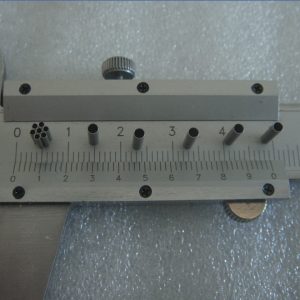
  • Dimensional precision: Outer diameter ranging from 0.1 mm to 12 mm, wall thickness as thin as 0.05 mm, with tolerances controlled within ±0.01 mm.
  • Outstanding machinability: Supports laser cutting, drilling, threading, flaring, bending, and welding for customized structural designs.
  • Sterilization compatibility: Withstands repeated autoclaving, ethylene oxide (EO), gamma irradiation, and low‑temperature plasma sterilization without deformation or property degradation.
These properties make medical stainless bone tubes far superior to titanium alloys in cost‑effectiveness and processability, while outperforming conventional 304 stainless steel in corrosion resistance and bio‑safety, striking an optimal balance for clinical application.

Manufacturing Process and Quality Control

The production of medical stainless bone tubes follows a fully controlled, traceable manufacturing chain from raw material to finished product, complying with ISO 13485, FDA 21 CFR Part 820, and other medical device regulations.
  1. Raw material preparation: High‑purity vacuum‑induction‑melted (VIM) or electroslag‑remelted (ESR) steel ingots ensure ultra‑low impurity levels and uniform microstructure.
  2. Tube forming: Hot extrusion or cold drawing processes shape billets into seamless tubes, with multiple annealing cycles to refine grain structure and improve ductility.
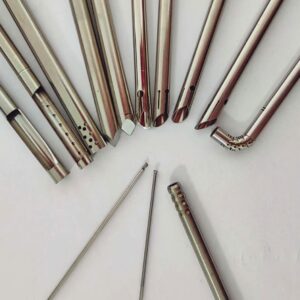
  3. Precision machining: Laser cutting, CNC machining, electrochemical drilling, and precision grinding achieve tight dimensional control and complex geometries.
  4. Surface treatment: Electropolishing, passivation, and mechanical polishing create a smooth, low‑roughness surface (Ra ≤ 0.2 μm) to reduce bacterial adhesion and tissue irritation.
  5. Cleaning and passivation: Ultrasonic cleaning, acid passivation, and high‑purity rinsing remove contaminants and form a protective chromium oxide layer.
  6. Sterilization and packaging: Final sterilization and hermetic, dust‑free packaging maintain cleanliness until clinical use.
Quality control covers chemical composition analysis, mechanical testing, corrosion resistance testing, biocompatibility assessment (ISO 10993), dimensional inspection, and non‑destructive testing (NDT) to ensure zero defects in every batch.

Clinical Applications in Orthopedics and Surgery

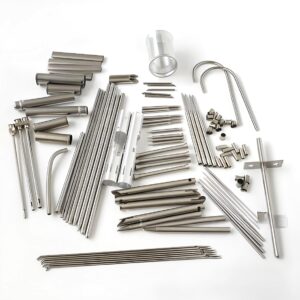
Medical stainless bone tubes serve as critical components across a wide spectrum of surgical disciplines, with core applications as follows:

Fracture Fixation and Intramedullary Devices

As hollow intramedullary nails, guide tubes, and screw barrels, they provide stable internal fixation for long‑bone fractures of the femur, tibia, humerus, and radius. The hollow design allows insertion of guide wires, dynamic compression, and minimally invasive insertion, reducing soft‑tissue damage and accelerating bone union.

External Fixation Systems

Used as connecting rods and support tubes in monolateral and circular external fixators (e.g., Ilizarov frames), they enable adjustable stabilization for complex fractures, limb lengthening, deformity correction, and bone transport in orthopedic reconstruction.

Minimally Invasive Surgical Instruments

As hypodermic tubes, endoscopic bone drills, curette guides, and arthroscopic sleeves, their small diameter and high rigidity facilitate precise access to deep anatomical sites, reducing surgical trauma and shortening hospital stays.

Spinal Surgery Devices

Applied in pedicle screw sleeves, intervertebral distractors, and endoscopic spinal tubes, they support spinal fusion, deformity correction, and minimally invasive discectomy with enhanced stability and accuracy.

Implantable Bone Repair Components

Used in bone graft delivery tubes, drug‑eluting implant carriers, and prosthetic joint connectors, they integrate with bone tissue while delivering therapeutic agents to promote osteogenesis and reduce infection risk.

Veterinary Orthopedics

Widely adopted in small and large animal fracture repair, joint reconstruction, and orthopedic implants, leveraging the same high performance at a more accessible cost.

Advantages Over Alternative Materials

Compared to titanium alloys, medical stainless bone tubes offer:
  • Lower cost: More affordable raw materials and simpler processing, reducing device manufacturing expenses.
  • Higher rigidity: Greater stiffness for primary stability in weight‑bearing applications.
  • Better machinability: Easier to cut, thread, and weld for complex custom parts.
Compared to polymer and biodegradable materials, they provide:
  • Superior mechanical strength: Resists fatigue and deformation under long‑term loading.
  • Long‑term durability: Maintains performance for permanent implant scenarios.
  • Radiopacity: Clearly visible under X‑ray for post‑operative monitoring.
These advantages make them the first choice for high‑strength, cost‑effective orthopedic components.

Development Trends and Future Innovations

Driven by advances in materials science and minimally invasive surgery, medical stainless bone tubes are evolving toward higher performance and smarter functionality:
  • High‑nitrogen, nickel‑free stainless steel: Reduces nickel‑related allergic risks while improving strength and corrosion resistance.
  • Micro‑textured and bioactive surfaces: Coatings such as hydroxyapatite (HA) enhance osseointegration and bone‑implant bonding.
  • Drug‑eluting and antibacterial modifications: Slow‑release antibiotic or growth factor coatings prevent infection and promote healing.
  • Ultra‑precision micro‑tubes: Miniaturized tubes below 0.3 mm for endoscopic spinal and intraosseous procedures.
  • Smart implant integration: Embedded micro‑sensors for in vivo monitoring of bone healing and implant stability.
  • Digital manufacturing: CNC and 3D printing enable patient‑matched custom bone tubes for personalized surgery.

    Contact Us


    has been added to your cart:
    Checkout