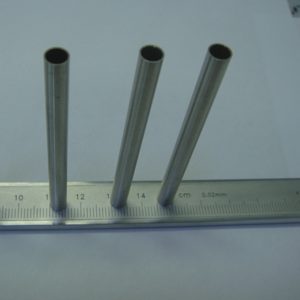
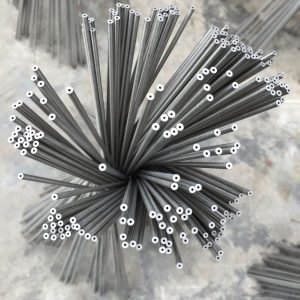
Stainless Medical Tubing Parts

Driven by technological innovation and clinical demand, the medical stainless tubing parts industry is moving toward miniaturization, intelligence, functionalization, and personalization.
Ultra-fine micro-tubes below 0.3mm in diameter will be more widely used in neurointervention, spinal endoscopy, and precision drug delivery systems. Surface modification technologies, such as hydroxyapatite coating and antibacterial coating, will enhance osseointegration and reduce infection risks.
The development of nickel-free and high-strength stainless steel will further improve product safety for metal-sensitive patients. Digital manufacturing technologies, including 3D printing and automated CNC processing, will enable patient-customized tubing parts for personalized surgical solutions.
In addition, the integration of micro-sensors into stainless steel tubing parts will create smart implantable devices capable of real-time monitoring of bone healing, pressure changes, and infection status, supporting dynamic clinical management.
Globally, the aging population, increased incidence of orthopedic diseases, and the popularity of minimally invasive surgery will continue to drive demand for high-quality medical stainless tubing parts. Emerging markets in Asia, Latin America, and the Middle East are accelerating medical device infrastructure construction, providing broad growth space for manufacturers with advanced technology and stable quality.
- Description
- Inquiry
Description
Medical stainless tubing parts are precision-engineered tubular components manufactured from medical-grade stainless steel alloys, designed exclusively for application in healthcare, orthopedics, interventional medicine, surgical instruments, implantable devices, and diagnostic equipment. Unlike general industrial tubing, these components are produced under stringent regulatory frameworks, including ISO 13485, FDA 21 CFR Part 820, and EU MDR, ensuring exceptional biocompatibility, mechanical stability, corrosion resistance, and cleanliness. As critical infrastructure in modern medical devices, medical stainless tubing parts support minimally invasive surgery, internal fixation, drug delivery, fluid management, and tissue engineering, significantly advancing clinical treatment precision, patient safety, and post-operative recovery efficiency. With the continuous expansion of global healthcare demand and the rapid development of minimally invasive and precision medicine, the technical requirements and market scale of medical stainless tubing parts are steadily increasing, making them an indispensable category in the medical device supply chain.
Material Classification and Core Performance Characteristics
The material selection of medical stainless tubing parts follows strict clinical safety standards, with material performance directly determining implant safety, service life, and surgical reliability. The most widely used materials include 316L, 316LVM, 304L, and high-nitrogen nickel-free stainless steel, each adapted to different application scenarios.
316L low-carbon surgical stainless steel is the most common material for medical tubing. Its low carbon content (≤0.03%) effectively prevents intergranular corrosion caused by carbide precipitation during welding and heat treatment, enhancing structural stability in long-term implantation. The addition of molybdenum significantly improves resistance to pitting and crevice corrosion in chloride-containing physiological environments such as blood, interstitial fluid, and saline, reducing the risk of ion precipitation and inflammatory reactions. For high-end implantable devices, 316LVM (vacuum-melted) stainless steel is preferred, which further reduces inclusions, impurities, and non-metallic particles through vacuum induction melting and electroslag remelting processes, meeting the strictest biocompatibility requirements for permanent implants.
304L stainless steel, though less corrosion-resistant than 316L, offers excellent formability and cost efficiency, making it suitable for non-implantable medical devices such as surgical instrument casings, fluid delivery tubes, and endoscopic accessories. In recent years, high-nitrogen nickel-free stainless steel has emerged as an innovative alternative, reducing nickel-related allergic risks while improving strength and fatigue resistance, particularly suitable for patients with metal sensitivity.
Key performance characteristics of medical stainless tubing parts include:
- Outstanding biocompatibility, complying with ISO 10993 standards, non-toxic, non-carcinogenic, and non-irritating to surrounding tissues.
- High mechanical strength and fatigue resistance, able to withstand repeated stress loads without deformation or fracture.
- Excellent corrosion resistance, maintaining structural integrity in complex physiological environments for long periods.
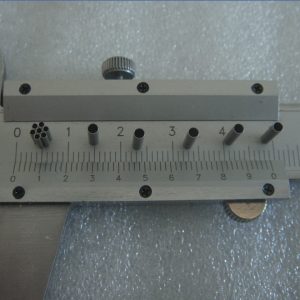
- Ultra-high dimensional precision, with outer diameters ranging from 0.1mm to 30mm, wall thickness as thin as 0.05mm, and tolerances controlled within ±0.01mm.
- Superior surface smoothness, with Ra ≤ 0.2μm after electropolishing, reducing bacterial adhesion and tissue friction.
- Compatibility with multiple sterilization methods, including autoclaving, ethylene oxide, gamma irradiation, and low-temperature plasma.
These comprehensive properties make medical stainless tubing parts irreplaceable in scenarios requiring both precision and biosecurity.
Precision Manufacturing Process and Quality Control System
The production of medical stainless tubing parts involves a highly standardized, fully traceable manufacturing process, from raw material inspection to finished product packaging. Strict quality control runs through every link to ensure compliance with medical regulatory requirements.
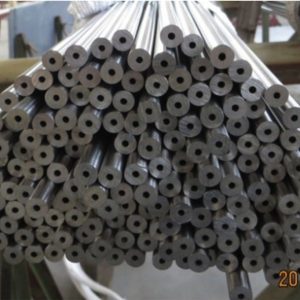
Raw materials must be supplied by certified manufacturers, with complete material test reports (MTR) verifying chemical composition, mechanical properties, and purity. The tube forming process mainly adopts cold drawing and cold rolling, which maintain fine grain structure and high dimensional accuracy. Multiple intermediate annealing treatments eliminate internal stress, improve ductility, and ensure stable performance during secondary processing.
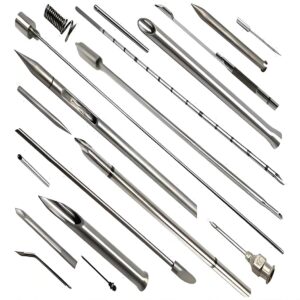
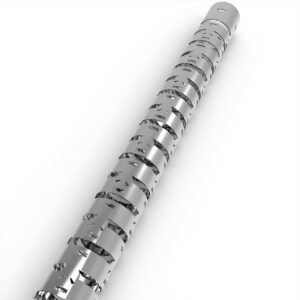
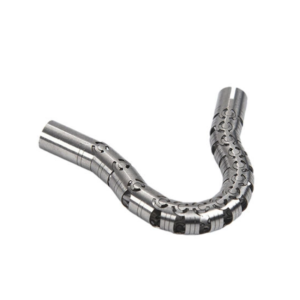
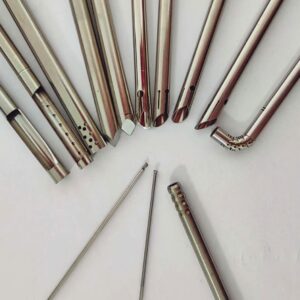
Precision machining includes laser cutting, CNC turning, electrochemical drilling, slotting, flaring, necking, bending, and threading. Laser processing enables micro-scale complex structures without burrs, meeting the miniaturization requirements of interventional devices. Surface treatment is critical: electropolishing removes surface impurities and forms a dense chromium oxide passive film, improving corrosion resistance and biocompatibility. Mechanical polishing and ultrasonic cleaning ensure cleanliness and eliminate potential contamination risks.
Final quality inspection covers dimensional measurement, surface roughness testing, mechanical performance testing, corrosion resistance testing, non-destructive testing, and biocompatibility evaluation. Each batch of products has a complete production and inspection record, supporting full life cycle traceability. Such rigorous processes distinguish medical stainless tubing parts from ordinary industrial products and ensure their safe application in the human body.
Wide Applications in Medical and Healthcare Fields
Medical stainless tubing parts are widely applied across multiple medical fields, supporting the core functions of various devices.
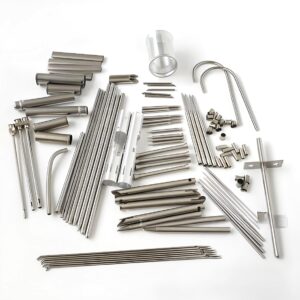
In orthopedics and traumatology, they are used as intramedullary nails, bone fixation screws, external fixator connecting rods, prosthetic joint components, and spinal implant sleeves. Their high strength and biocompatibility provide stable internal fixation for fractures, promote bone healing, and support limb reconstruction and deformity correction.
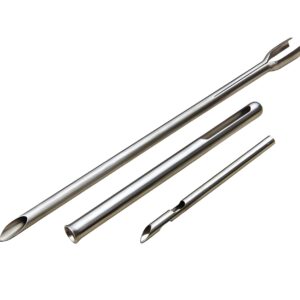
In minimally invasive surgery, micro-diameter stainless steel tubes serve as endoscopic sleeves, arthroscopic instruments, catheter sheaths, and surgical guide tubes. Their small size, rigidity, and smooth surface allow surgeons to access deep lesions with minimal trauma, reducing bleeding, shortening hospital stays, and accelerating patient recovery.
In interventional cardiology and vascular surgery, precision stainless steel tubes are used in stent delivery systems, balloon catheters, guide wires, and blood access devices. Their flexibility and kink resistance ensure safe navigation in complex vascular pathways.
For drug delivery and fluid management, medical stainless tubing parts are used in infusion systems, syringe components, surgical suction tubes, and drug-eluting implant carriers. The smooth inner wall prevents fluid residue and bacterial growth, ensuring drug delivery efficiency and hygiene.
In dental and aesthetic medicine, stainless steel tubes are applied in dental handpieces, endodontic instruments, implant abutments, and micro-cannulas for cosmetic injections, combining precision, strength, and corrosion resistance.
In veterinary medicine, medical stainless tubing parts are also widely used in small and large animal fracture repair, orthopedic implants, and surgical instruments, sharing the same high-performance standards as human medicine.
Comparative Advantages Over Alternative Materials
Compared with titanium alloy tubes, medical stainless steel tubes offer higher rigidity, better machinability, and lower production costs, making them more suitable for high-strength, cost-sensitive mass-produced devices. Although titanium has better biocompatibility, its high price and difficult processing limit its widespread use in general medical instruments.
Compared with polymer and biodegradable tubes, stainless steel tubes provide superior mechanical strength, long-term durability, and excellent radiopacity, allowing clear visualization under X-ray during surgery and post-operative review. Polymers often lack sufficient strength for load-bearing orthopedic applications, while biodegradable materials are unsuitable for permanent implantation.
Compared with pure metal tubes such as nickel-titanium alloy, stainless steel tubes have better structural stability and lower elastic deformation, making them ideal for fixed-support and positioning components.